Hydrocarbon Predictor

Introducing our cutting-edge pre-prospecting tool. A revolutionary solution that harnesses the power of unsupervised learning and agglomerative clustering to transform post-stack seismic interpretation. By integrating four key seismic attributes: flatness, brightness, low frequency anomalies, and minor fault/fracture swarm delineation.
This innovative technology isolates hydrocarbon signatures from geologic noise and stratigraphic complexities. Our product delivers highly detailed, automated insights, ensuring that exploration efforts target the most promising reservoirs with unprecedented precision.
Designed to streamline workflows and reduce tedious manual processing, our solution empowers geoscientists to focus on deep analysis and critical decision-making. Experience significant improvements in accuracy and efficiency, paving the way for faster, smarter exploration strategies and optimized resource management.
Facies & Faluvial

Our frequency decomposition technology revolutionizes seismic interpretation through unsupervised AI and machine learning. By leveraging advanced signal decomposition, the system efficiently identifies fluvial deposits and stratigraphic facies without the need for manual intervention. Using Nyquist frequency principles, aliasing correction, and weighted median calculations for frequency bucket distribution, our AI optimizes spectral decomposition to enhance geological clarity and improve predictive modelling.
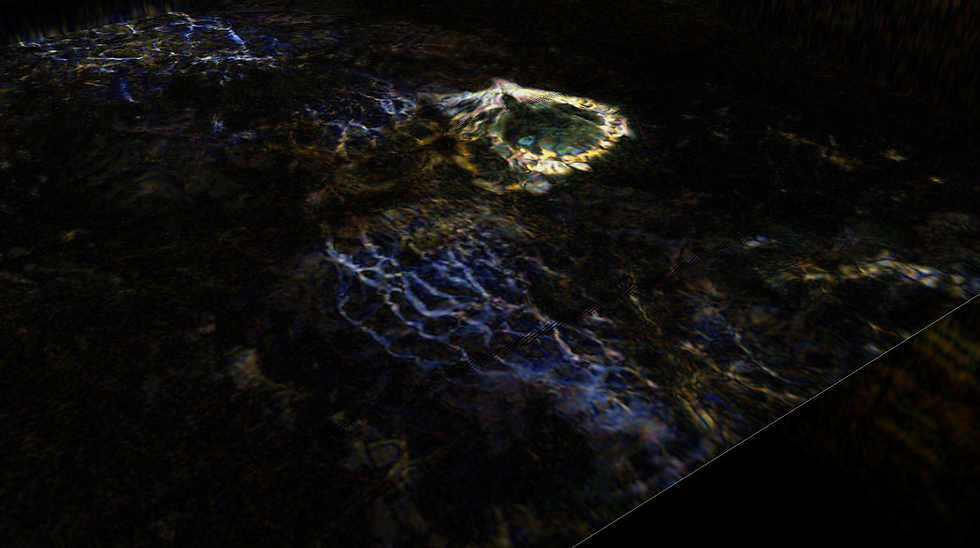
Through power law-based spectral analysis and RGB blending, the attribute processes seismic frequency bands to maximize visualization of depositional environments. The selection of optimal frequency bands ensures precise identification of channelized systems, floodplain formations, and structural geology, all vital for hydrocarbon exploration and reservoir characterization. With agglomerative clustering, our AI autonomously groups seismic features, delivering data-driven geological insights. Whether refining exploration prospects or optimizing reservoir development, our adaptive, data driven, attributes provide unparalleled precision, efficiency, and scalability.

Fault and Fracture Swarm Detection
Fault segmentation has traditionally been challenged by issues such as noise interference and limited detail resolution, resulting in incomplete or ambiguous fault mapping. Our innovative approach leverages unsupervised AI and machine learning to address these challenges holistically. The process integrates advanced edge detection, meticulous edge enhancement, and robust noise reduction techniques to isolate genuine geologic signals from surrounding noise.

By employing these automated steps, our system effectively delineates even the minor faults and intricate fracture swarms that are critical to understanding subsurface structures. This refined segmentation capability has been rigorously validated with image logs, demonstrating an accuracy exceeding 90%.
The resulting high-fidelity fault maps provide clear insights into fluid migration secondary porosity, and reservoir compartmentalization, empowering geoscientists to make informed, data-driven decisions.

Salt Deliniation
Salt delineation plays a pivotal role in seismic interpretation, yet traditional methods often struggle with accurately capturing the complex geometries of salt bodies in 3D post-stack data. Our AI-powered salt delineation technology addresses these challenges with a dedicated edge detection algorithm specifically designed for salt body segmentation. When combined with our proprietary geological dip calculation, this solution delineates salt features with exceptional precision-avoiding the pitfalls of over- or underestimating salt flanks and edges.


Additionally, our system effectively suppresses noise and mitigates the impact of adjacent faulting, yielding a clean, isolated representation of salt structures ready for automatic modeling and extraction. This comprehensive approach not only enhances the reliability of subsurface models but also streamlines workflows, providing geoscientists with a robust tool to optimize exploration and development strategies through improved salt body characterization.
Dip Estimation
Traditional dip estimation techniques in seismic interpretation rely on voxel-based analysis, which inherently limits measurements to one voxel laterally and one voxel vertically. This constraint restricts accurate dip measurements to a maximum of 45 degrees, as the system cannot resolve movements smaller than a single voxel in any direction. Such limitations often result in significant underestimations of dip in steeply dipping regions, impacting subsequent structural and reservoir analyses.


Our proprietary AI solution revolutionizes dip estimation by virtually "rotating the world" to realign the seismic data, allowing for precise calculation of local dips beyond the conventional 45-degree barrier. The technology iteratively recalculates the dip within the transformed domain and then rotates the data back to its original orientation. This adaptive process grants highly accurate dip measurements even in complex geological settings, ultimately leading to enhanced structural interpretation and improved risk assessment.